
This article explains the 3GPP release timeline, key features of 5G, the evolution to 5G-Advanced, and what to expect toward 6G. It is written for telecom engineers, planners, and technology professionals.
What is 3GPP?
3GPP (3rd Generation Partnership Project) is the global organization responsible for developing mobile communication standards. It defines specifications for 2G, 3G,4G and 5G Technologies standards, covering radio access, core networks, security, and services.
3GPP works through releases, where each release introduces new features while maintaining backward compatibility. These releases shape how mobile networks evolve over time.
Why 3GPP Releases Matter in Telecom
Each 3GPP Release:
- Introduces new capabilities (speed, latency, reliability)
- Enhances network efficiency and scalability
- Enables new use cases (IoT, automation, XR, AI-driven networks)
- Guides vendor roadmaps and operator deployments
Understanding releases helps engineers and planners know what exists today and what is coming next.
📘 3GPP Release Timeline with Main Features
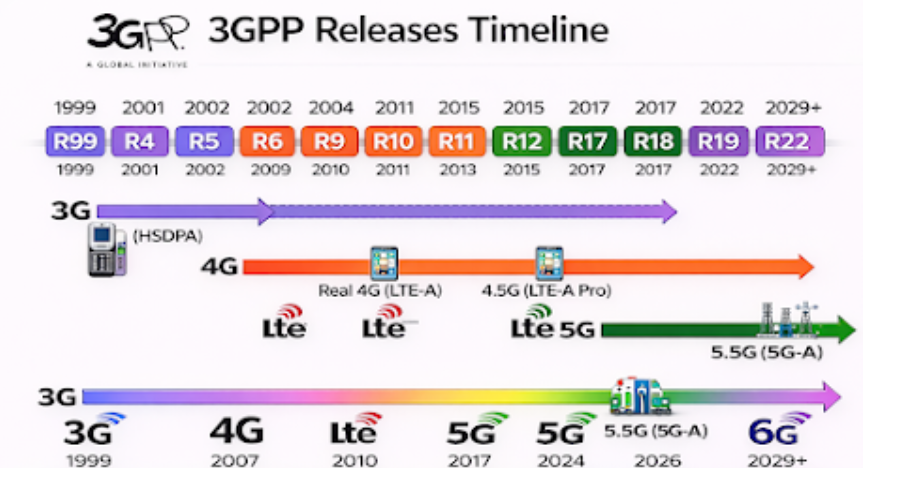

📊 3GPP Releases – Key Comparison
🔹 Release 15 (2018–2019) – 5G Foundation
Focus: Initial 5G deployment
Key Features:
- First definition of 5G NR
- 5G NSA (Non-Standalone) architecture
- EN-DC (LTE + NR dual connectivity)
- Early support for eMBB (enhanced Mobile Broadband)
Impact:
- Enabled early 5G launches
- Relied heavily on LTE core and infrastructure
🔹 Release 16 (2020) – 5G Enhancement Phase
Focus: Performance and reliability
Key Features:
- 5G Standalone (SA) enhancements
- URLLC (Ultra-Reliable Low Latency Communication)
- Industrial IoT support
- Integrated 5G positioning
- Improved network slicing
Impact:
- Made 5G suitable for enterprise and industrial use
- Strengthened reliability and low-latency performance
🔹 Release 17 (2022–2023) – 5G Expansion
Focus: New devices and coverage
Key Features:
- RedCap (Reduced Capability devices) for IoT
- NR-Light for wearables and sensors
- Non-Terrestrial Networks (NTN) – satellite integration
- Improved energy efficiency
- Coverage enhancement for rural areas
Impact:
- Expanded 5G beyond smartphones
- Enabled satellite-based 5G scenarios
🔹 Release 18 (2024–2025) – 5G-Advanced (Start)
Focus: Intelligence and performance evolution
Key Features:
- AI/ML-assisted radio optimization
- Enhanced XR / AR / VR support
- Improved uplink performance
- Advanced mobility management
- Higher spectral efficiency
Impact:
- Marks the beginning of 5G-Advanced
- Bridges the gap toward 6G concepts
🔹 Release 19 (Expected 2025–2026) – 5G-Advanced Evolution
Focus: Automation and intelligence
Expected Features:
- Deeper AI-native network functions
- Improved energy-efficient designs
- Advanced positioning and sensing
- Support for new enterprise use cases
- Preparation for 6G requirements
🔹 Release 20 (Future) – Pre-6G Phase
Focus: Transition toward 6G
Expected Direction:
- AI-first network design
- Integrated sensing and communication
- Extreme reliability and ultra-low latency
- Sustainability and energy optimization
📌 Summary: What to Expect from 5G 3GPP Releases
Short-Term (Now – Release 18)
- Wider 5G SA adoption
- Better performance and reliability
- More enterprise and industrial use cases
Mid-Term (Release 19)
- Strong AI integration
- Smarter, self-optimizing networks
- Enhanced automation
Long-Term (Release 20+)
- Transition toward 6G
- AI-native, sustainable networks
- New communication paradigms